What Happened in the Bhote Koshi Flood of Nepal?
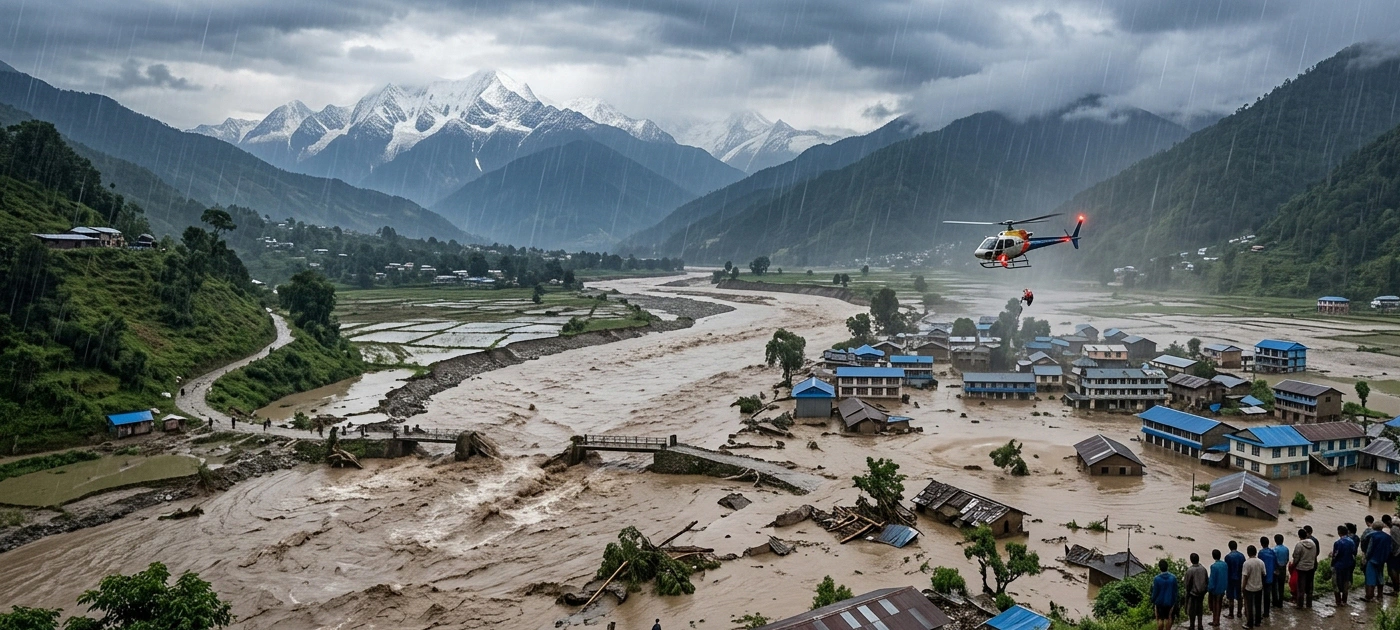
On August 26, 2026, a powerful flash flood struck the Bhote Koshi river system in northern Nepal. The event was associated with a major glacial and rockfall-related disaster near the Nepal–China border, sending an enormous volume of water, mud, rocks and debris downstream.
The flood moved rapidly through the Himalayan river valleys, leaving very little time for communities in some areas to respond.
According to Nepal's Ministry of Foreign Affairs, the flood caused extensive damage to houses, roads, bridges, hydropower facilities and other critical infrastructure. Search and rescue agencies, security forces, health workers and local authorities were mobilized immediately.
Why Was the Flood So Destructive?
The scale of destruction was not caused by ordinary monsoon rainfall alone. The disaster involved a sudden release of water and debris associated with a glacial and high-altitude geological event.
The Himalayan region contains glaciers, unstable mountain slopes and rapidly changing high-altitude environments. When large quantities of ice, rock and water move suddenly into a river system, the resulting flood can become much more powerful than a normal river flood.
The August 2026 disaster demonstrates how several hazards can combine in the Himalayas: glacial instability, landslides, debris flows, heavy monsoon conditions and rapidly rising river levels.
Areas Affected by the Bhote Koshi Flood
The disaster particularly affected areas along the Bhote Koshi and connected downstream river systems.
The flood caused serious damage in parts of Rasuwa and neighboring districts, while downstream areas also experienced destruction and flooding. Satellite observations documented damage to roads, bridges, settlements and hydropower infrastructure along the affected river system.
The disaster also affected the important Nepal–China transport and trade corridor toward the Rasuwagadhi–Kerung border. Several bridges and sections of road were damaged or swept away, making rescue and transportation extremely difficult.
Damage to Roads, Bridges and Infrastructure
One of the biggest challenges after the flood has been access.
Roads connecting remote Himalayan settlements were damaged by floodwater, landslides and debris. Bridges were also swept away, cutting off communities and making it difficult for rescue teams to reach affected areas.
The damage extends beyond transportation. Hydropower projects and electricity infrastructure were also heavily affected. Nepal's hydropower sector is particularly important because a significant portion of the country's electricity generation comes from Himalayan river systems.
The destruction of infrastructure has therefore created both an immediate humanitarian challenge and a major long-term reconstruction requirement.
Impact on the Nepal–China Border
The Bhote Koshi river corridor is strategically important because it connects Nepal with Tibet, China.
The flood severely damaged infrastructure around the northern border region and disrupted movement along the Nepal–China trade corridor. The damage has affected not only local communities but also transportation, tourism, pilgrimage and cross-border commerce.
Travelers heading toward the Tibet border and destinations such as Kerung have also been affected by the disruption.
Authorities are working to establish alternative routes and restore access where possible.
Impact on Tourism and Travelers
The disaster has also had a significant impact on tourism.
The affected region is an important gateway for travelers heading toward the Nepal–China border and Tibet. The flood has disrupted transportation routes and affected some tourists and pilgrims who were in the region when the disaster occurred.
For travelers planning a Nepal trip, however, it is important to understand that the Bhote Koshi flood is a regional disaster and does not mean that the entire country is inaccessible.
Many major tourist destinations in Nepal are outside the directly affected Bhote Koshi corridor. Travel conditions should nevertheless be checked carefully before visiting areas close to the affected river systems.
At Asian Adventure Treks & Expedition, we recommend that travelers remain flexible during the monsoon season and follow the latest information from local authorities before traveling toward affected regions.
Search, Rescue and Relief Operations
Following the disaster, Nepal's security forces, disaster-management agencies, local authorities and medical teams were mobilized for search and rescue.
Helicopters and specialized rescue teams have been used to reach isolated communities, evacuate people and deliver essential supplies.
The difficult Himalayan terrain, damaged roads and bridges, continuing rainfall and unstable slopes have made rescue operations extremely challenging.
The Government of Nepal has also continued monitoring river levels because further rises in water levels could create additional risks in already damaged areas.
Is It Safe to Trek in Nepal Right Now?
This is the question we're hearing most from our clients, and it deserves an honest, clear answer: it depends on where you're going.
Nepal is a large and geographically diverse country. The flooding affected specific river corridors and districts, it did not affect the entire country. Many of Nepal's most popular trekking regions are operating normally. At the same time, some areas connected to the disaster zone need caution and, in some cases, a change of plan.
Areas Currently Affected
- Langtang Valley Trek – Access through Syabrubesi has been badly disrupted, though the upper valley toward Kyanjin Gompa is reported safe for trekkers already there.
- Gosaikunda Trek – This route passes close to the affected zone.
- Tamang Heritage Trail – Shares the same Syabrubesi starting point, and is currently affected by road damage.
- Helambu Circuit Trek – Ground transport from Kathmandu to trailheads like Sundarijal and Melamchi Bazar is currently blocked.
- Ruby Valley Trek – A key bridge connecting to Dhadingbesi has collapsed.
- Nepal-China border route to Kailash – The Gyirong crossing is destroyed, and this route is closed for the foreseeable future.
Areas Operating Normally
Popular routes such as the Everest region, Annapurna region, and most other classic trekking trails across Nepal are unaffected by this event and continue to welcome trekkers as usual. If your trip doesn't pass through the districts listed above, there is generally no reason to cancel your plans.
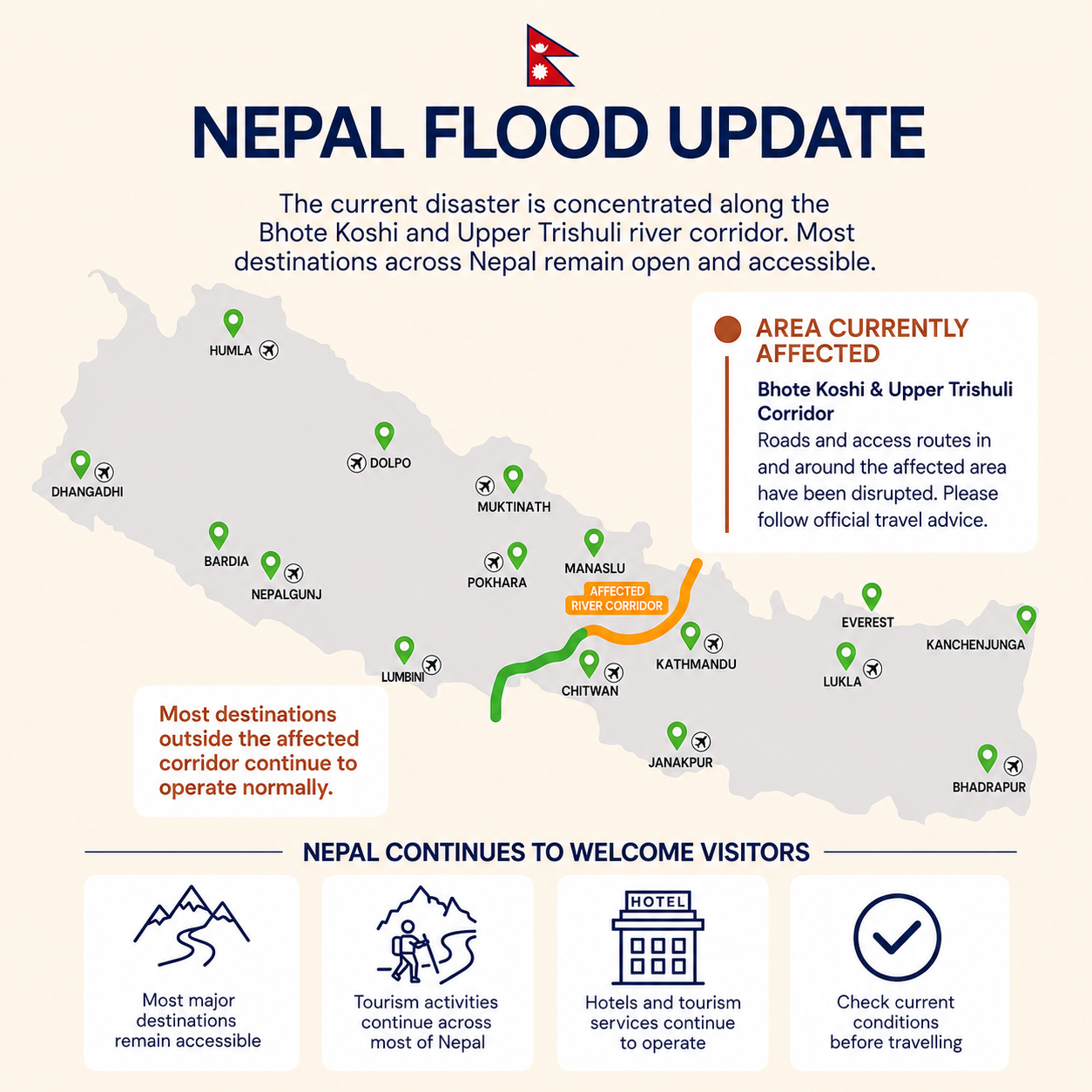
Everest, Annapurna, Manaslu and Other Major Trekking Regions
Status: TRAILS UNAFFECTED
The August 26 flood has not affected the main trekking trails as mentioned below:
- Everest Base Camp
- Gokyo Valley
- Everest Three Passes
- Annapurna Base Camp (ABC)
- Annapurna Circuit
- Ghorepani–Poon Hill
- Mardi Himal
- Manaslu Circuit
- Tsum Valley
- Upper Mustang Trek / Tour
- Other trekking areas outside the affected corridor (Langtang & Kerung Border)
These regions are located in different geographical and river systems from the Bhote Koshi–Trishuli disaster zone. Current reports indicate that their trekking trails remain unaffected.
One important point: while the trekking trails themselves may be unaffected, road access from Kathmandu can change because of monsoon landslides or flood damage elsewhere. Always check the road condition immediately before travelling to a trailhead.
Planning a Trip to Nepal This Autumn?
If you are planning to visit Nepal in September, October or November 2026, there is no need to cancel your entire Nepal trip simply because of the Bhote Koshi disaster.
Generally suitable alternatives include:
Everest Region
Everest Base Camp, Gokyo, Everest Three Passes and other Khumbu treks remain outside the affected area.
Annapurna Region
Annapurna Base Camp, Annapurna Circuit, Ghorepani–Poon Hill and Mardi Himal are separate from the disaster zone.
Manaslu Region
Manaslu Circuit and Tsum Valley are also outside the Bhote Koshi flood corridor.
Kanchenjunga Region
Kanchenjunga Circuit Trek, Kanchenjunga North Base Camp & Kanchenjunga South Base Camp Trek.
Kathmandu, Pokhara, Lumbini and Chitwan
These major tour destinations remain open to travellers are totally unaffected by the flood of Nepal.
For travellers with an itinerary that includes Rasuwa or Langtang or Kailash through kerung route (land border), contact your trekking agency can assess the situation and recommend a safer alternative if necessary.
What to do - If You Have a Trek Booked this Autumn?
If you already have a trekking holiday booked for autumn 2026, do not panic and do not cancel your entire Nepal trip immediately.
First, speak with your trekking agency.
If your itinerary is for Everest, Annapurna, Manaslu or another unaffected region, the flood does not automatically require cancellation.
If your trip includes Langtang, Tamang Heritage, Gosaikunda or the Rasuwagadhi border, your operator should review the route and provide the latest access information.
A responsible trekking company should:
- Check the latest road and trail conditions
- Monitor government and local authority notices
- Communicate directly with guests
- Offer an alternative trekking route where appropriate
- Avoid sending travellers through damaged roads or bridges
- Keep flexible travel days during the recovery period
NEPAL IS OPEN
The images from Rasuwa are heartbreaking, and our thoughts are with everyone who has lost family members, homes and livelihoods in this tragedy.
At the same time, it is important to avoid portraying the disaster as a crisis affecting the whole of Nepal.
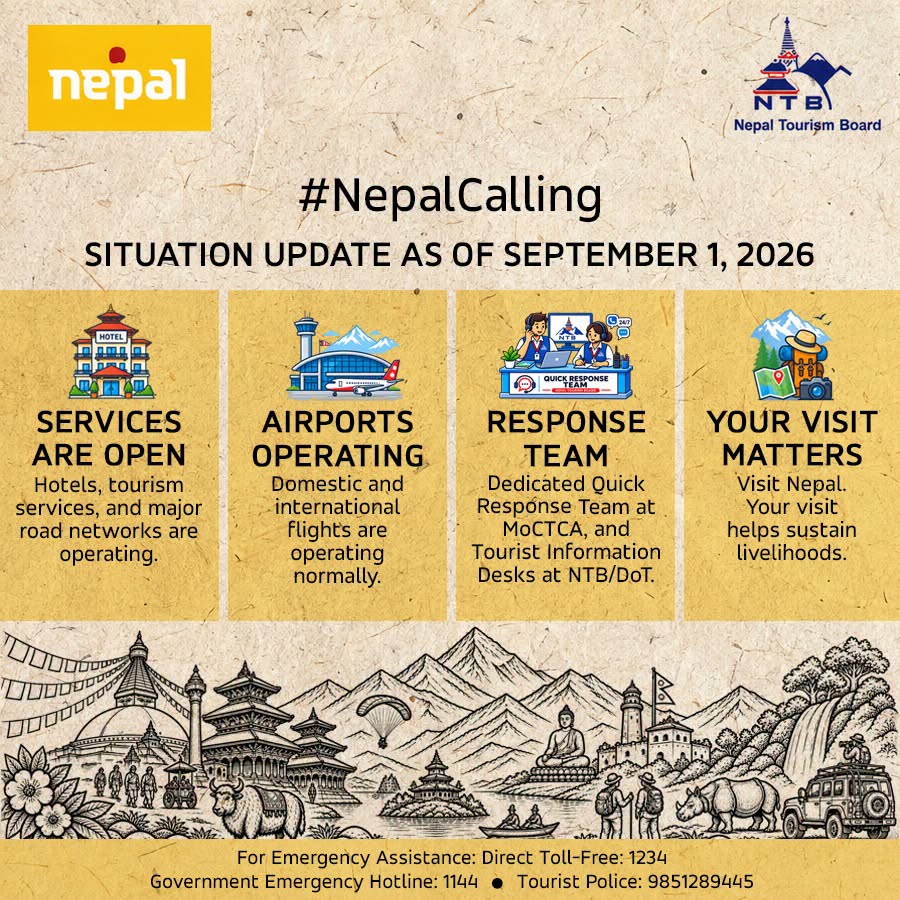
Our Advice to Trekkers and Travelers
If you already have a booking with us, or are planning one, here is what we recommend:
- Talk to your agency directly. Don't rely on outdated news or social media alone. Reach out to us and we will give you the most current, accurate picture for your specific route.
- Stay flexible. If your itinerary touches an affected area, we may recommend an alternate route or a short postponement, not a cancellation of your Nepal trip altogether.
- Avoid riverbanks and unconfirmed crossings. If you are currently trekking in or near the affected districts, follow instructions from local authorities, your guide, and the Nepal Tourism Board.
- Don't confuse normal monsoon weather with an emergency. Rain, cloud cover, and minor trail mud are a normal part of trekking in Nepal. This flood was a distinct, sudden event, not typical monsoon conditions.
- Check official sources. For the latest verified updates, follow the Nepal Tourism Board, Ministry of Home Affairs, and NDRRMA (National Disaster Risk Reduction and Management Authority).
Why We Believe Nepal Tourism Will Recover
Nepal has faced natural disasters before, including the devastating 2015 earthquake, and each time, the mountains, the trails, and the people have shown remarkable resilience. Tourism is not just an industry here; it is a lifeline for thousands of families in trekking communities, from teahouse owners to porters and guides. Responsible travel, now and in the coming months, will be part of how these communities recover.
As a company registered with the Nepal Tourism Board (NTB), and proud members of PATA, NMA, TAAN, NATTA, and VITOF-Nepal, safety has always been our first priority in every itinerary we design. We are closely monitoring the situation and will continue to update our clients honestly, whether that means confirming a trip is safe to proceed or recommending changes to protect your wellbeing.
Planning a Trek? We're Here to Help
If you have an upcoming trek booked with Asian Adventure Treks & Expedition (AATE), or are considering one, please reach out to our team. We will walk you through the current situation for your specific route and help you make the right decision, with your safety always coming first.
Nepal's mountains are still here, still beautiful, and still worth visiting. We simply ask every traveler to trek with awareness, patience, and respect for the communities currently going through a difficult time.
— Team AATE
This blog reflects information available as of August 31, 2026. Conditions are changing quickly; please contact us directly for the latest updates before finalizing any travel plans.