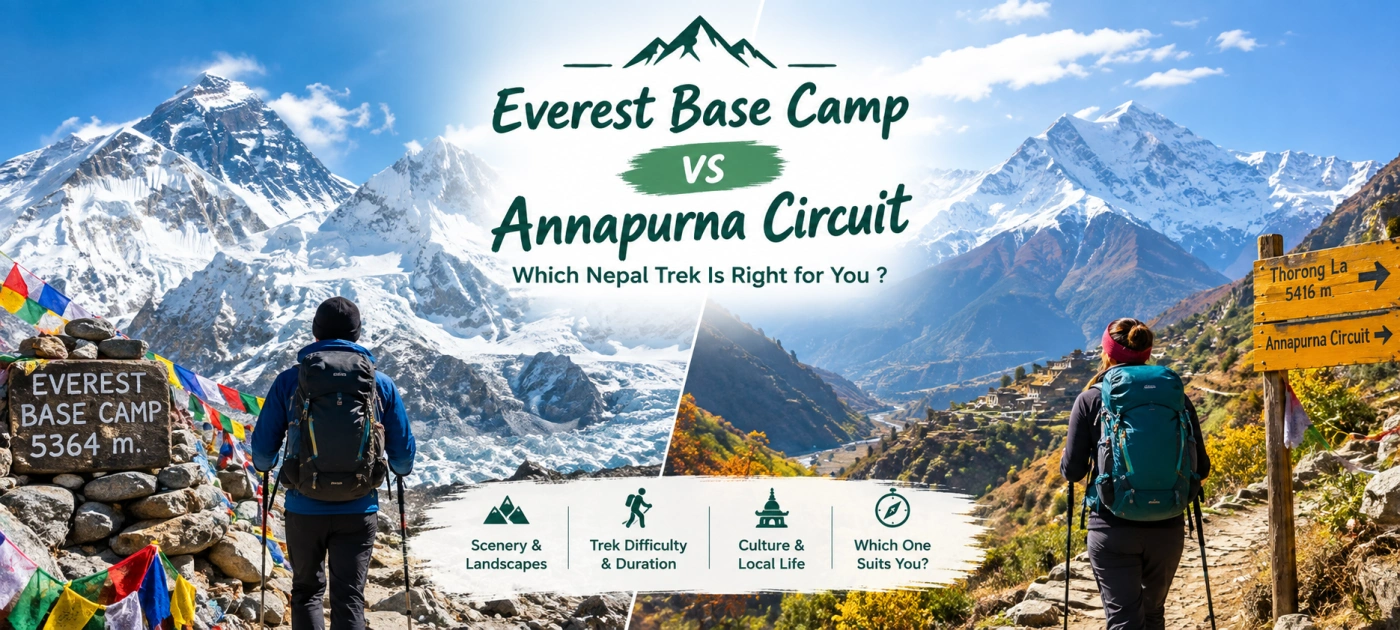
The Everest Base Camp Trektakes you deep into the Khumbu region, through Sherpa villages and Buddhist monasteries, toward the base of Mount Everest. The highest point is usually Kala Patthar at about 5,545 meters (18,192 feet), while Everest Base Camp itself sits at approximately 5,364 meters (17,598 feet).
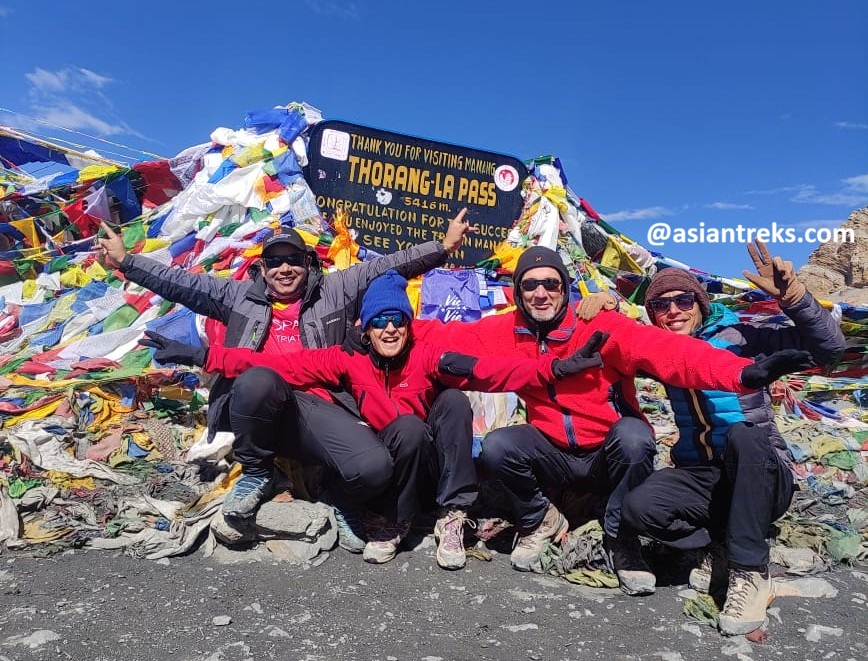
The Annapurna Circuit Trek, meanwhile, takes you around the Annapurna massif through dramatically changing landscapes—from subtropical valleys and forests to high Himalayan terrain and the Tibetan-influenced Manang and Mustang regions. Its highest point is Thorong La Pass at 5,416 meters (17,769 feet).
Nepal Tourism Board describes Everest and Annapurna among Nepal's most popular trekking regions.
So, which one should you choose?
The answer depends on what you want from your Nepal adventure.
If your dream is to stand beneath Mount Everest, Everest Base Camp may be the route that best matches your goals.
If you want more landscape diversity, cultural variety, and a journey that feels like a changing geographical expedition, the Annapurna Circuit may be more appealing.
This guide compares the two treks to help you decide.
Everest Base Camp VS Annapurna Circuit: Quick Comparison
|
Feature
|
Everest Base Camp
|
Annapurna Circuit
|
|
Region
|
Everest Region / Khumbu
|
Annapurna Region / Manang / Mustang
|
|
Highest point
|
Kala Patthar – 5,545 m
|
Thorong La Pass – 5,416 m
|
|
Main attraction
|
Mount Everest, Sherpa people and Khumbu
|
Annapurna massif, Tibetan culture and diverse landscapes
|
|
Typical duration
|
Around 14–16 days (options for Gokyo Lake / Everest 3 pass & so on..)
|
Around 14–18+ days, depending on route (Tilicho Lake can be added)
|
|
Difficulty
|
Moderate to Challenging
|
Moderate to Challenging
|
|
Landscape
|
High Himalayan valleys, glaciers, alpine terrain
|
Forests, valleys, high mountains, dry Tibetan-style landscapes
|
|
Culture
|
Strong Sherpa and Tibetan Buddhist influence
|
Gurung, Manang, Thakali and Tibetan-influenced cultures
|
|
Accommodation
|
Teahouses/lodges (premium options available)
|
Teahouses/lodges (premium options available)
|
|
Major high point
|
Kala Patthar (5545 m)
|
Thorong La Pass (5416 m)
|
|
Main access
|
Flight from Kathmandu to Lukla & back
|
Road access toward Besisahar/Dharapani & Pokhara - Kathmandu
|
|
Best for
|
Everest dream, Sherpa culture, high-altitude scenery
|
Landscape diversity, mountain views, cultural variety
|
|
Ideal seasons
|
Spring / Autumn + Winter
|
Spring / Autumn + Summer & Winter
|
These are general comparisons. Exact duration and route can vary depending on your starting point, transportation, acclimatization days, side trips, and itinerary design.
What is Everest Base Camp Trek?
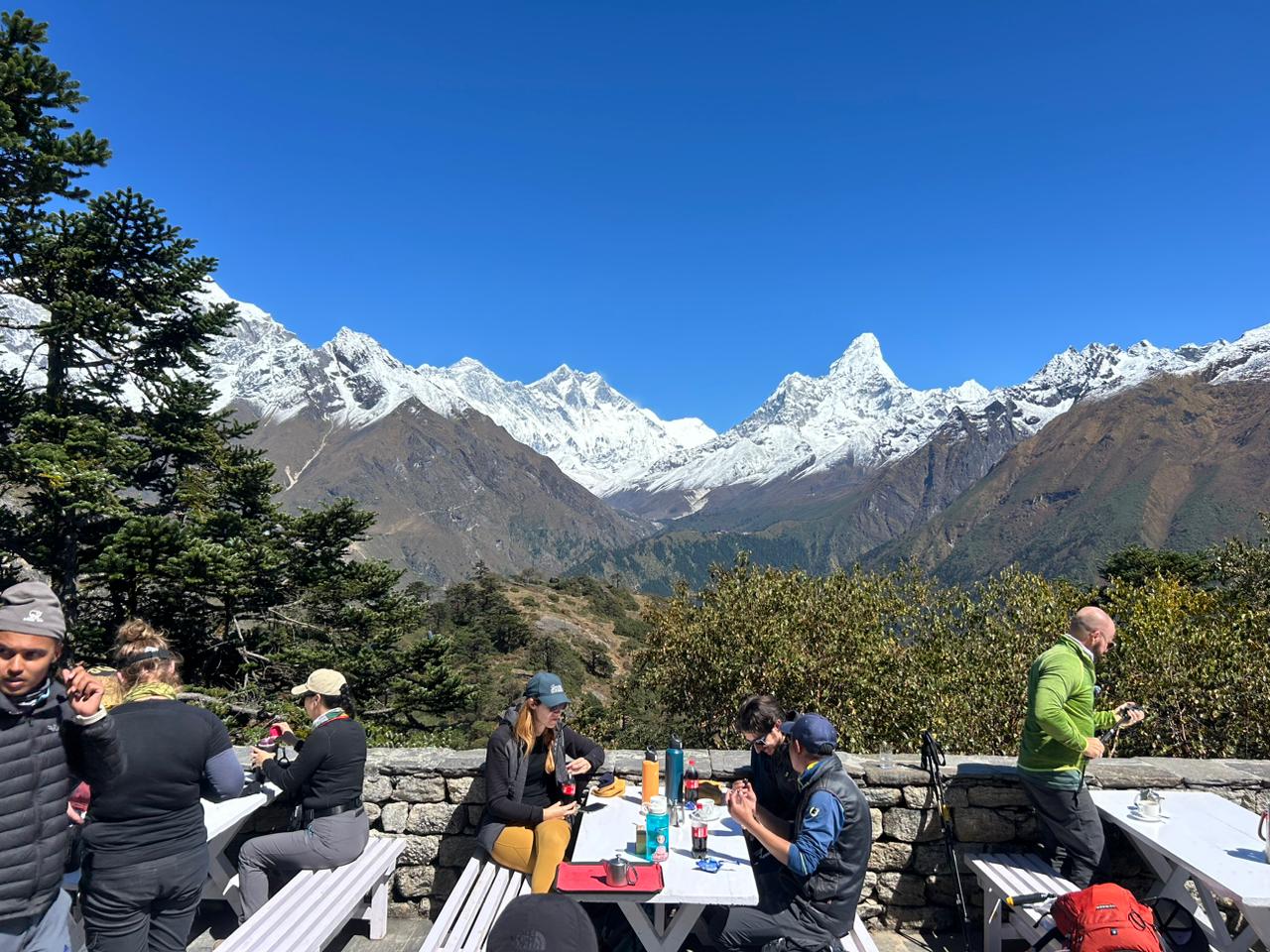
Everest Base Camp Trek is one of Nepal's best-known trekking journeys where you get to see the closer view of Mount Everest and even be on the lap of mighty - Everest Base Camp.
The classic route begins in the Khumbu region and generally uses Lukla as the gateway. From there, trekkers walk through villages such as Phakding and Namche Bazaar before continuing toward Tengboche, Dingboche, Lobuche, Gorak Shep and Everest Base Camp.
Everest Base Camp journey begings by taking one of the scenic flight from Kathmandu to Lukla and then takes approximately two-week beginning and ending around Lukla, with Namche Bazaar serving as an important acclimatization stop.
This Everest Base Camp trek is getting popular in 2027 as one of the Winter Trek in Nepal where you can take direct flight from Kathmandu to Lukla and enjoy more peaceful and amazing snow-capped mountain views of Everest Region along with Mount Everest (8848 m).
The journey isn't only about reaching Base Camp of Everest.
Along the way, you'll experience:
- Sherpa villages
- Buddhist monasteries
- Prayer wheels and mani walls
- High suspension bridges
- Namche Bazaar
- Tengboche Monastery
- Ama Dablam
- Lhotse
- Everest
- Khumbu Glacier
- Kala Patthar
- Everest View Hotel (Hotel at highest altitude) along with Khumjung village visit
- Chance to see Yeti Scalp in the Khumjung monastery
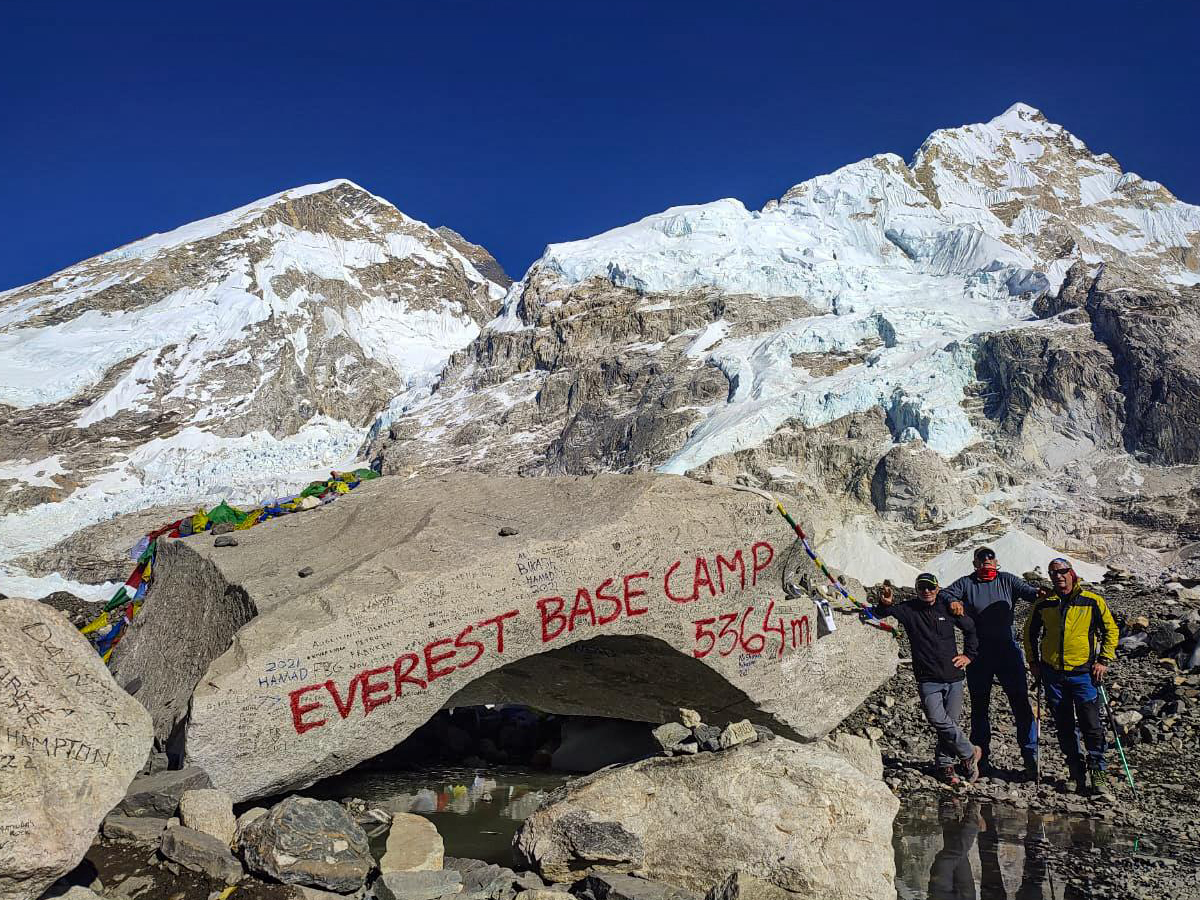
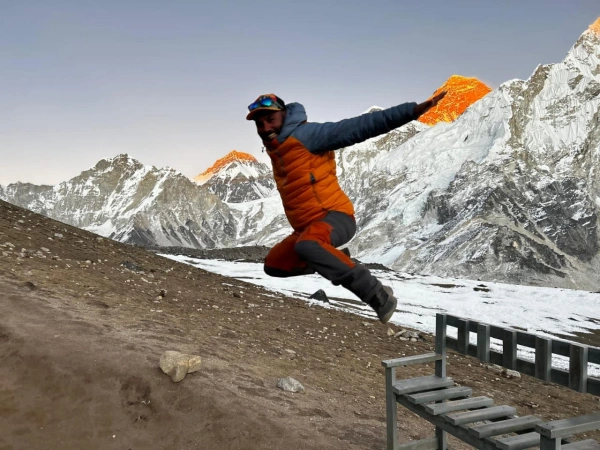
One of the highlights is reaching Kala Patthar, which provides a panoramic mountain viewpoint and is generally higher than Everest Base Camp itself. From the top trekkers can enjoy a spectacular panorama of Mount Everest, Nuptse, Lhotse, Pumori, Amadablam, and the surrounding Khumbu Himalayas.
For many international travelers, including first-time visitors to Nepal, Everest Base Camp is attractive because it combines a clear objective—reaching the base of the world's highest mountain—with a well-established trekking infrastructure and options for some premium hotels too on the way to Base Camp.
Sometimes, travellers also like to add Everest Base Camp trek with Gokyo Lake Trek or Everest Three Pass trek for more adventure and experience.
What is Annapurna Circuit Trek?
The Annapurna Circuit is a very different kind of Himalayan journey.
Rather than trekking toward one destination and returning along roughly the same corridor, the route travels around the Annapurna massif and crosses Thorong La Pass at 5,416 meters.
The landscapes change dramatically as you travel through the region.
You may begin in lower-elevation valleys surrounded by greenery and terraced farmland before gradually entering the higher mountain environment of Manang. Beyond the pass, the scenery becomes increasingly dry and Tibetan-influenced before the route continues toward Muktinath and the Kali Gandaki area.
Annapurna Circuit Trek has more accessibility with road upto Manang (and Khangsar for the ones doing Annapuran Circuit with Tilicho Lake Trek) - along the way route passes through forests, high Himalayan terrain and trans-Himalayan landscapes, with Thorong La as its high point.
A typical journey may include places such as:
- Dharapani
- Chame
- Pisang (Lower & Upper Pisang) with visits to beautiful villages like: Dhikur Pokhari and so on..
- Manang (Hike to: Gangapurna lake, ice lake, historic monastery)
- Yak Kharka
- Thorong Phedi / High camp (very basic accomodation & foods)
- Thorong La Pass
- Muktinath (very sacred Hindu as well as Buddhist temple)
- Marpha (one of the most beautiful village of Lower Mustang)
- Jomsom (headquarter of Mustang)
- Pokhara (beautiful city of Lakes)
The exact itinerary depends on road conditions, available time and the version of the circuit you choose.
At Asian Adventure Treks & Expedition, for example, our shorter Annapurna Circuit itinerary begins around Besisahar/Dharapani, crosses Thorong La and continues toward Muktinath and Pokhara.
Everest Base Camp vs Annapurna Circuit: Which Has Better Mountain Views?
This is one of the hardest categories to compare because the mountain scenery is spectacular on both routes—but in different ways.
Everest Base Camp Trek
Everest Base Camp is particularly strong if your priority is high-altitude Himalayan scenery. The scenery becomes increasingly dramatic as you move toward the upper Khumbu.
Ama Dablam, in particular, becomes a memorable companion along the trail.
The biggest attraction, of course, is Everest.
Annapurna Circuit Trek
The Annapurna Circuit offers greater landscape diversity.
Instead of spending most of your journey in one high mountain valley, the route gradually changes from green hills and forests to alpine terrain and then dry, high-altitude landscapes.
The route also takes you through the dramatic Kali Gandaki region.
Below is the comparison lists of Mountains seen from Everest & Annapurna Circuit Trek:
|
Everest Base Camp
|
Annapurna Circuit
|
|
Mount Everest
|
Annapurna I
|
|
Lhotse
|
Annapurna II
|
|
Nuptse
|
Annapurna III
|
|
Ama Dablam
|
Annapurna IV
|
|
Thamserku
|
Dhaulagiri
|
|
Kangtega
|
Manaslu
|
| |
Tilicho Peak
|
| |
Nilgiri
|
Which iconic Trek should you choose as a first time trekker?
If you want the iconic Everest experience, choose Everest Base Camp. If you want changing landscapes and a broader Himalayan journey, consider the Annapurna Circuit.
Everest Base Camp vs Annapurna Circuit: Which Is More Difficult?
Neither trek should be treated as an easy vacation. And trekkers should always respect the mountain and follow the guidelines and safety precautions suggested by Trekking guide during any trek in Nepal.
Both - Everest & Annapurna Trek require preparation, particularly because they reach elevations above 5,000 meters. However, the challenges are somewhat different.
Everest Base Camp (EBC) Difficulty
The biggest challenge is altitude. EBC trek is graded Moderate to Challenging.
The trek gradually takes you higher through the Khumbu Valley. Acclimatization days are an important part of a responsible itinerary.
At high altitude, even a person who is physically fit at sea level can feel the effects of reduced oxygen.
Daily walking commonly involves several hours on mountainous trails, with uphill and downhill sections.
The high point of many EBC itineraries is Kala Patthar at approximately 5,545 meters.
Asian Adventure Treks currently describes its 15-day Everest Base Camp itinerary as moderate and recommends good physical fitness, with trekkers generally prepared to walk around 5–6 hours per day.
Annapurna Circuit Trek Difficulty
The Annapurna Circuit also involves significant altitude, with Thorong La reaching 5,416 meters. The trek is graded Moderate to Challenging as well.
One of its challenges is the famous pass-crossing day - Thorong La Pass.
Depending on the itinerary, you may make an early start from Thorong Phedi or High Camp, climb to Thorong La and then descend toward Muktinath.
The route also includes varied terrain and long trekking days.
Asian Adventure Treks & Expedition shorter Annapurna Circuit itinerary describes the trek as moderate and notes that trekking days can involve approximately 6–8 hours of walking.
So which trek is harder - Everest Base Camp or Annapurna Circuit?
There is no universal answer.
Your experience will depend on:
- Fitness
- Acclimatization
- Itinerary length
- Weather
- Previous hiking experience
- How your body responds to altitude
- Daily walking hours
A longer, better-paced itinerary can be more comfortable than a rushed itinerary on either route.
Everest Base Camp vs Annapurna Circuit for First-Time Trekkers
Both routes can be suitable for first-time Himalayan trekkers who prepare properly. However, "first-time trekker" does not mean "no preparation required."
You should be comfortable walking for several hours a day on uneven terrain and be prepared for significant altitude.
Everest Base Camp for beginners
- EBC can work well for first-time trekkers because the route is well established and has numerous teahouses along the main trail.
- The journey also has a very clear objective.
- You know where you're going: Everest Base Camp.
- However, the altitude should never be underestimated.
Annapurna Circuit Trek for beginners
- The Annapurna Circuit is also accessible to first-time trekkers who are physically prepared.
- Its major advantage is the variety of terrain and communities you encounter.
- Modern road access has also changed sections of the traditional route, allowing itineraries to be shortened or customized.
- For travelers with limited vacation time, this can be useful.
What should a first-time American trekker do?
Don't choose based only on which trek sounds easier.
Instead, consider different points like:
- How many days do you have?
- How much high-altitude trekking experience do you have?
- Do you want Everest specifically?
- Would you rather experience a changing landscape?
- How comfortable are you with long walking days?
After knowing your trek requirements, we can then adjust the itinerary accordingly.
Everest Base Camp vs Annapurna Circuit: Which Has More Cultural Experiences?
Both routes offer strong cultural experiences, but the cultures you encounter are different.
Everest: Sherpa Culture
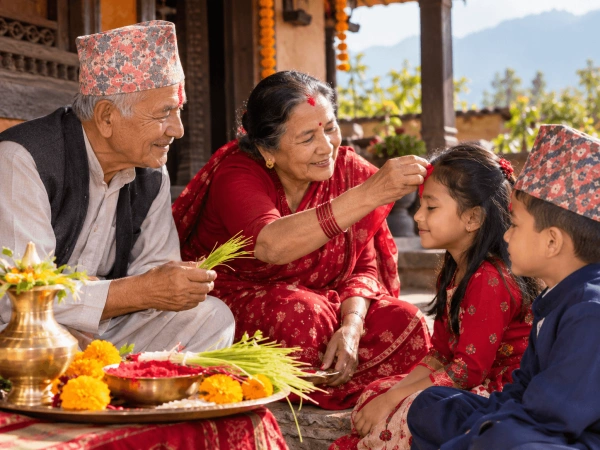
The Everest region is strongly associated with Sherpa communities and Tibetan Buddhist traditions.
Namche Bazaar is an important trading and tourism center, while villages throughout the Khumbu provide opportunities to see monasteries, prayer wheels, mani walls and traditional mountain life.
Tengboche Monastery is one of the most recognizable cultural landmarks on the route.
Nepal Tourism Board also highlights the Sherpa communities and Buddhist monasteries of the Everest region as important parts of the trekking experience.
Annapurna: Multiple Communities and Traditions
The Annapurna Circuit provides a different cultural experience.
As you move around the massif, you encounter communities including Gurung, Manang and Thakali populations, along with strong Tibetan Buddhist influence in the higher valleys.
The landscape changes together with the culture.
Lower valleys feel different from Manang, and Manang feels different again from the Mustang side of the route.
For travelers who want to combine trekking with cultural diversity, this is one of the major attractions of the Annapurna Circuit.
Which Trek Has Better Accommodation - EBC or Annapurna Circuit Trek?
Both Everest Base Camp and Annapurna Circuit are classic lodge / teahouse treks. This means you generally don't need to carry a tent, stove and complete camping kitchen.
Instead, you stay in locally operated lodges and teahouses.
Rooms are usually simple, with beds and blankets. Bathrooms may be shared depending on the location.
As you reach higher elevations, facilities become more basic.
You should expect:
- Simple rooms
- Shared or private bathrooms depending on the lodge
- Dining rooms
- Hot meals
- Tea and coffee
- Charging facilities in many lodges, often for an additional fee
- Wi-Fi in many locations, although connectivity varies
NOTE: Premium Accommodation
Premium accommodation is available on both the Everest Base Camp and Annapurna Circuit treks, although premium lodges are not available at every stop along the routes.
Depending on the itinerary, we can arrange the best available premium hotels and lodges at different locations. This allows you to enjoy a higher level of comfort where premium accommodation is available while staying in the best available local lodges at more remote stops.
During peak trekking seasons, popular lodges can become busy. Advance planning is particularly useful for private groups and travelers with specific accommodation preferences.
Everest Base Camp vs Annapurna Circuit: Which Is More Scenic?
This comes down to the type of scenery you prefer.
Choose Everest Base Camp if you want:
- Huge Himalayan peaks
- Glacial landscapes
- High-altitude valleys
- Everest views
- Sherpa villages
- Buddhist monasteries
- Iconic Himalayan landmarks
Choose Annapurna Circuit if you want:
- Green valleys
- Forests
- Waterfalls
- High mountain landscapes
- Tibetan-style terrain
- Dry mountain valleys
- Diverse communities
- Dramatic changes in scenery
The Annapurna Circuit's diversity is one of its defining characteristics. Nepal Tourism Board describes the region as encompassing everything from forested middle mountains to high Himalaya and trans-Himalayan desert-like landscapes.
Everest Base Camp vs Annapurna Circuit: Which Takes Longer?
A classic Everest Base Camp itinerary generally takes around 14–16 days, depending on the exact itinerary and acclimatization schedule.
Asian Adventure Treks & Expedition currently offers a 15-day Everest Base Camp itinerary.
The Annapurna Circuit can be customized considerably, basic shorter options starting from 14 days (Kathmandu Arrival to Departure from Kathmandu)
A shorter version can be completed in around two weeks, while longer itineraries can include additional destinations such as Tilicho Lake or Poon Hill.
For example, Asian Adventure Treks offers a 14-day short Annapurna Circuit itinerary and an 18-day itinerary combining the Annapurna Circuit with Tilicho Lake.
This flexibility can be particularly useful for American travelers planning around limited vacation time.
When is the Best Time for Everest Base Camp and Annapurna Circuit?
The two major trekking seasons are generally spring and autumn.
1. Spring: (March to May)
Spring brings warmer temperatures and blooming rhododendrons in lower areas.
It is a popular period for trekking, with generally favorable conditions and mountain views.
2. Autumn: (September to November)
Autumn is traditionally one of the most popular trekking periods.
After the monsoon, visibility is often excellent and the trails are generally dry.
For travelers coming from the United States, October and November are particularly popular months to consider.
3. Winter: December to February
Winter trekking is possible and very much preffered in recent days with bookings available for Everest Base Camp Trek 2027/ 2028, while temperatures can be colder at high elevations - but with sleeping bags, spikes (crampons) - and lodges trek becomes enjoyable.
For Annapurna Circuit Trek the High passes such as Thorong La may experience snow and difficult conditions - for which crampons are essential / with proper gear the trek can be successfully completed. And during winter Annapurna Circuit offers one of the best and panoramic views of the himalayas.
3. Summer/Monsoon: June to August
Monsoon affects much of Nepal, bringing rain, clouds and potentially muddy trails.
However, not every destination is equally affected. Some areas, including parts of the Mustang region, lie in a rain shadow. So Annapurna Circuit Trek can be combied with Narphu Valley Trek whcih is summer trek of Nepal. And this trek can be done in Summer as well.
If your vacation dates are fixed during summer, speak with a Nepal trekking specialist before deciding which route to take.
Which Trek Is Better for American Travelers?
There is no single "best" trek for every American traveler. Instead, match the trek to your travel priorities! As per your dates, interest, season - your best reccomended / suited trek can be organized.
Choose Everest Base Camp if:
- You have always dreamed of seeing Mount Everest.
- You want a classic Himalayan trekking experience.
- You are interested in Sherpa culture and Buddhist monasteries.
- You want to visit Namche Bazaar and Tengboche.
- You don't mind reaching very high altitude.
- You want the satisfaction of reaching Everest Base Camp and Kala Patthar.
Choose Annapurna Circuit if:
- You want a variety of landscapes.
- You enjoy cultural diversity.
- You want to cross a high mountain pass.
- You want flexibility in your itinerary.
- You have around two weeks or more.
- You want to combine trekking with destinations such as Muktinath, Mustang or Pokhara.
- You prefer a trek where the scenery changes dramatically throughout the journey.
Everest Base Camp vs Annapurna Circuit: What About Cost?
The total cost depends on several factors, including:
- Trek duration
- Number of travelers (bigger the group, lower the price)
- Guide and porter services
- Accommodation level (basic / attached rooms / premium lodges)
- Domestic transportation (private / local)
- Permits (necessary & must)
- Meals (options with meals or without)
- Kathmandu and Pokhara hotel nights (3-star / 4-star / 5-star category)
- Travel insurance (essential / must)
- Personal expenses
- Optional upgrades
For an American traveler, remember that the trek package is only one part of your total Nepal travel budget.
You should also plan for:
- International airfare
- Nepal visa
- Travel insurance
- Emergency evacuation coverage
- Personal gear
- Tips
- Additional hotel nights
- Drinks and snacks
- Wi-Fi and charging fees
- Souvenirs
Do You Need a Guide for Everest Base Camp or Annapurna Circuit?
This is an important question for anyone planning a trek in Nepal.
Nepal Tourism Board's current TIMS guidance lists both Everest Base Camp and Annapurna Circuit among trekking routes where a licensed trekking guide and agency-issued TIMS are required under the current rules.
Regulations can change, so travelers should confirm the latest requirements before departure.
A licensed local guide can also provide practical support beyond permits.
Your guide can help with:
- Route navigation
- Accommodation
- Daily itinerary
- Altitude awareness
- Communication with local lodges
- Weather-related decisions
- Emergency coordination
- Cultural interpretation
- Risky areas and safety to be adopted
- Help incase of emergency situation
- Guide you and take care with altitude and sickness situation
For international travelers who are unfamiliar with Himalayan trekking, local support makes the journey considerably easier to manage.
What Permits Do You Need?
Permit requirements depend on the route.
For Annapurna, travelers generally need the Annapurna Conservation Area Permit (ACAP) and the applicable TIMS arrangement.
For Everest, permits and entry requirements include the applicable Everest national park and Khumbu Gaupalika Permit (local/regional) requirements.
Nepal Tourism Board currently lists Sagarmatha National Park and Annapurna Conservation Area among protected areas requiring entry permits.
If you're booking through a trekking agency, permit arrangements are normally handled as part of the pre-trek preparation.
What Should You Pack for Trekking in Nepal?
Your packing list will vary depending on the season and itinerary, but the essentials generally include:
- Good trekking boots
- Trekking socks
- Base layers
- Fleece or insulating layer
- Down jacket
- Waterproof jacket
- Trekking pants
- Warm hat
- Gloves
- Sunglasses
- Sunscreen
- Water bottles or hydration system
- Headlamp
- Trekking poles
- Sleeping bag suitable for the season
- Personal medication
- Basic first-aid supplies
- Passport and travel documents
- Travel insurance details
For high-altitude routes, don't underestimate the importance of warm clothing and sun protection.
Altitude: The Most Important Difference to Understand
Both routes reach more than 5,000 meters. That means altitude is a serious consideration regardless of which trek you choose.
The key principle is gradual acclimatization. Don't assume that being physically fit automatically means you are protected from altitude-related problems.
A well-designed itinerary should include appropriate acclimatization and reasonable daily elevation gains. If you develop symptoms that concern you, tell your guide immediately. Do not attempt to hide symptoms simply because you want to complete the trek.
Your health should come before the itinerary. Travel insurance with appropriate trekking and emergency evacuation coverage is also an important part of planning a high-altitude trek.
Everest Base Camp or Annapurna Circuit: Which One Should You Book?
The easiest way to decide is to ask yourself one question:
What do I want my Nepal trek to be about?
If the answer is:
- "I want to stand beneath Mount Everest."
Then Everest Base Camp (EBC) is the obvious route to investigate.
If your answer is:
- "I want to experience as much variety as possible—mountains, villages, forests, high passes and changing cultures."
Then the Annapurna Circuit Trek may be the route to consider.
Neither trek needs to be treated as a competition. They simply offer different ways to experience Nepal. While one offers the Khumbu side (southern side) of Nepal whereas another offers the North Central (Manang, Mustang) side of Nepal.
And if you're still undecided, an experienced local trekking company can help you compare itineraries based on your available vacation time, fitness level, preferred travel style and interests.
Trek Nepal with Asian Adventure Treks & Expedition
At Asian Adventure Treks & Expedition, we have been organizing trekking adventures in Nepal since 2002. Our Kathmandu-based team works with travelers from different countries to arrange guided, private and customized Himalayan journeys.
For Everest Base Camp, we offer customized itineraries as well as scheduled departures, with options ranging from classic EBC journeys to extended routes such as Gokyo and Cho La.
For Annapurna, we can arrange shorter and longer versions of the circuit, including itineraries incorporating Tilicho Lake and Poon Hill.
Our current Everest Base Camp program is a 15-day itinerary, while our Annapurna options include a 14-day short circuit and longer combinations.
We can assist with:
- Airport transfers
- Hotels in Kathmandu
- Trekking permits
- Licensed trekking guides
- Porters
- Teahouse accommodation
- Meals during the trek
- Transportation
- Domestic flights where applicable
- Trekking equipment advice
- Emergency coordination
- Customized itineraries
Whether you are traveling from the United States or any foreign nation as a couple, family, group of friends or private group, we can adjust the itinerary according to your available time and interests.